 US-Based & Operated
Stem Cells · Clinician-directed
Stem cells, explained without the hype.
Donor-derived mesenchymal stromal/stem cells, explained clearly—from sourcing and screening to processing, testing, and the evolving research.

Source
Donated umbilical cord tissue
Process
Cell isolation & culture
Testing
Lot-specific characterization
The basics
What exactly is an MSC?
A mesenchymal stromal/stem cell (MSC) is a living cell studied for its ability to self-renew, differentiate into specialized cell types, and communicate with surrounding cells through biological signaling.
Self-renewal
MSCs can divide to produce more cells like themselves, maintaining a population in culture.
Differentiation
Under the right conditions, MSCs can differentiate into certain specialized cell types, which is why they are described as multipotent.
Signaling
MSCs also release signaling molecules and extracellular vesicles that researchers study for their role in cell-to-cell communication and interactions with surrounding tissue.
MSC terminology
You'll see both “mesenchymal stem cell” and “mesenchymal stromal cell” used in scientific literature. Throughout this site, we use MSC when discussing this cell population.
The source
Why umbilical cord tissue?
Not all stem cells come from the same place. The cells discussed here come from a specific, non-embryonic tissue that has been studied for decades.
Non-embryonic
Umbilical cord tissue is collected following birth. It is not embryonic tissue, and no embryo is involved in obtaining the tissue.
A well-studied source
Umbilical cord tissue is a recognized source of mesenchymal stromal/stem cells studied extensively in scientific research.
Screened and documented
Donated tissue undergoes donor-eligibility screening, applicable communicable-disease testing, and documentation before cells are isolated and processed.
Umbilical cord tissue source from AATB-accredited establishment with this tissue category within scope of accreditation.
Learn about AATB accreditation
Where they come from
From a single donation to a documented lot
From donor eligibility and tissue acceptance through cell isolation, culture, testing, and lot documentation, each step follows a documented process. donor screening through cell isolation, culture, testing, and lot documentation.
- Birth
- Voluntary donation
- Donor eligibility & screening
- Umbilical cord tissue
- Cell isolation & culture
- Testing & lot documentation
How is the donor screened?
Donor eligibility is assessed following applicable requirements for human tissue recovery, including review of the birth mother's medical and social history and laboratory screening for communicable diseases, consistent with the source establishment's procedures.
What happens if screening or testing doesn't meet requirements?
Tissue or product that does not meet the applicable donor-eligibility or release criteria is not released for routine use under those criteria. Specific disposition follows the source establishment's standard operating procedures.
Can the tissue be traced?
Each lot is documented so material can be traced through processing records back to its donor source. Lot-specific documentation is available to your clinician on request.
In the lab
Why cell expansion matters
After cells are isolated from umbilical cord tissue, they can be cultured to increase the cell population. How that expansion is controlled, documented, and characterized is an important part of understanding a cellular product.
- Cell culture
Expansion
Cells are cultured under controlled conditions to increase the available cell population.
- Population doublings
How extensively has the culture expanded?
Each round of cell division contributes to the cumulative population-doubling history of the culture.
- Characterization
How is the cell population evaluated?
Cell identity and defined characteristics are evaluated as part of lot documentation.
What repeated expansion can look like
Cells change as they are repeatedly expanded in culture. Researchers evaluate factors such as morphology, growth characteristics, phenotype, and cellular senescence when studying the effects of prolonged expansion.

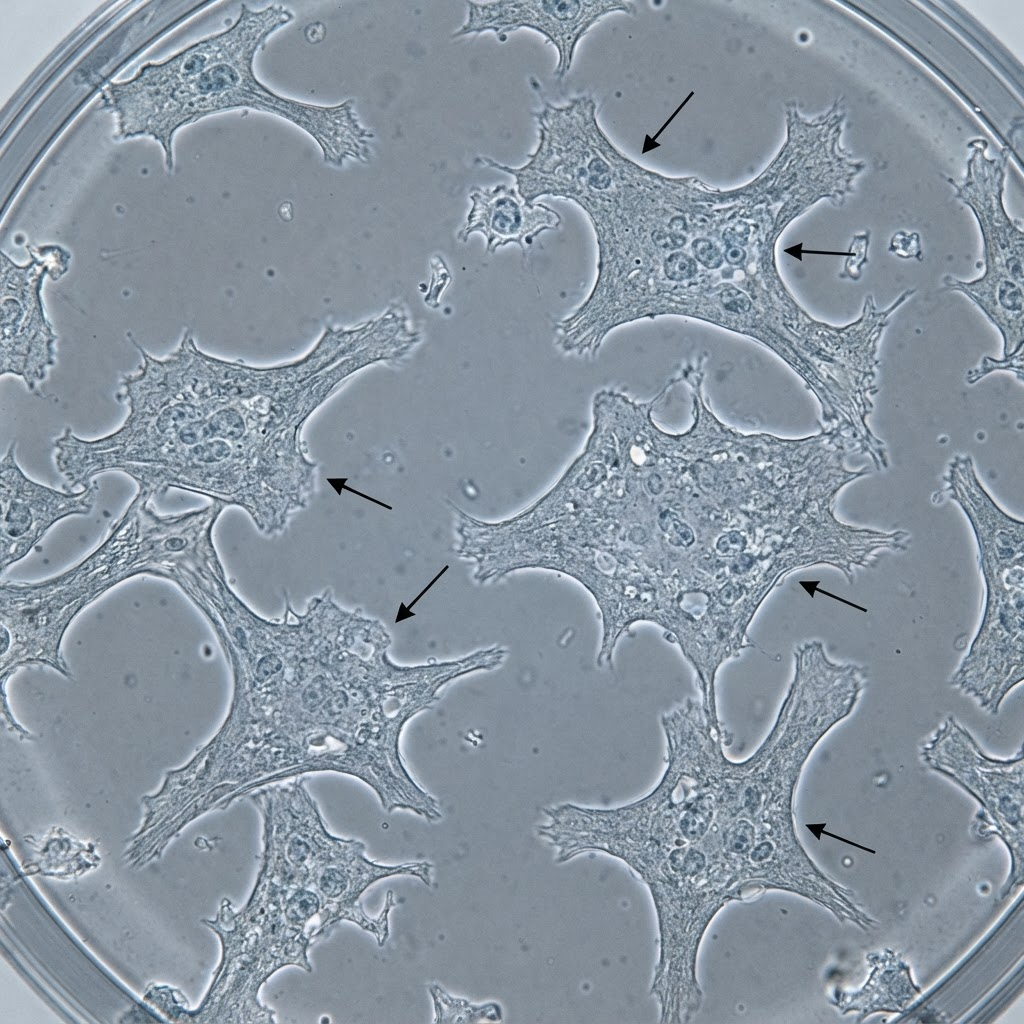
Representative microscopy shown for educational illustration; morphology varies by donor, culture conditions, and laboratory methods.
A general range shown for orientation. No point on this scale represents a universal cutoff between acceptable and unacceptable cells.
- Morphology
- More uniform, spindle-shapedMay become larger or flatter
- Proliferation
- Generally more robustMay decline
- Senescence
- LowerMay increase
- Consistency
- Monitored throughoutFurther expansion can introduce changes
Why we track it
Population-doubling history is one part of understanding how extensively a cell population has been expanded before characterization and cryopreservation.
Microscopy images are representative illustrations of how cultured cells can change with expansion — not a depiction of any specific lot, and not a potency claim. Population doubling is not a universal quality score; tissue source, donor, culture conditions, and assays all matter.
What's in the vial
What does “25 million cells” actually mean?
A cell count is the number most people notice first — but on its own it says very little. What actually describes a lot is the full set of documented attributes behind that number.
Target cell quantity
A documented target describes the intended cell quantity for the lot. Cell count is important — but it is only one part of understanding the product.
Viable after thaw
The percentage of cells determined to be viable following cryopreservation and thaw, documented for the lot.
MSC characterization
Marker-based characterization is used to evaluate whether the cell population demonstrates characteristics associated with mesenchymal stromal/stem cells.
Sterility & safety testing
Applicable microbiological and safety-related testing documented for the lot.
Cryopreservation
Why storage and thawing conditions are controlled — handling affects what actually reaches the point of use.
A bigger number isn't automatically “better.” The meaningful information is what's documented for the specific lot — not the headline figure alone.
How viability and identity are evaluatedViability & characterization
What testing a lot actually means
Cell count tells you how many. Viability evaluates how many cells remain viable. Characterization examines the properties used to describe the cell population. Safety-related testing evaluates defined release criteria. Together, these create a more complete picture of a specific lot.
Cell count
How many cells are documented?
Viability
What percentage are viable at the measured time point?
Identity / characterization
What characteristics were evaluated to describe the cell population?
Safety-related testing
What microbiological and other applicable release testing was performed?
The important word is “lot-specific.”
Testing should connect to the specific lot being evaluated — not simply to general testing performed on a product category or manufacturing process.
View sample lot documentationFDA registration ≠ FDA approval
FDA registration describes a registered establishment. It does not mean FDA has approved a specific product or its use.
Lot-specific quality
A sample Certificate of Analysis, annotated
Rather than hand you a raw certificate, here is a real released lot's COA walked through field by field — what each line is, and what it actually tells you. Every value is transcribed exactly from the document.
Certificate of Analysis for Human MSC
3D UCT-MSCs XF · Lot 3D-A1-2508-D
- 1
Lot number
3D-A1-2508-D
Identifies this exact production lot. Every result on the certificate applies only to this lot — not to the product in general.
- 2
Manufacture & release dates
Manufactured Jan 2026 · Released Mar 3, 2026
When the lot was produced, and when it cleared testing and was released.
- 3
Cell count
≈ 23 million cells per vial
Total viable cells documented for the vial, measured by automated cell count.
- 4
Viability
95.8%
The percentage of cells that were viable when measured at release, by automated cell count.
- 5
Safety-related testing
Sterility: No growth · Mycoplasma: Negative · Endotoxin: < 0.005 EU/mL
Microbiological release testing measured against fixed pass/fail specifications, consistent from lot to lot.
- 6
Laboratory & certification
Stem Nova · Spring, TX
The establishment issuing the certificate and certifying the lot meets its release criteria for GMP-grade material.
Every lot is released with its own Certificate of Analysis. Safety assays are tested against a fixed release specification and are consistent from lot to lot; measured values such as cell count and viability are reported for each individual lot and vary. The figures below are transcribed from one real released lot as an example — a lot's own COA is the authoritative record, and a COA documents testing, not an FDA approval or any treatment claim.
What researchers are studying
Where are MSCs being studied?
MSC research sits at different points on the evidence spectrum depending on the question being asked. Understanding whether evidence comes from laboratory studies, human clinical research, or established clinical evidence is essential when interpreting what a study actually tells us.
- Stage 1
Biological rationale
Why researchers are interested
Laboratory studies show MSCs release signaling molecules and extracellular vesicles and interact with the cells around them. These observed behaviors are why researchers form hypotheses worth testing — but a rationale is a starting point, not evidence of a clinical effect.
- Stage 2
Human clinical research
Being studied in people
MSCs are the subject of registered clinical trials investigating safety and potential activity across many areas. This work is investigational: trials are how questions get answered, and a trial existing does not mean a use has been proven or approved.
- Stage 3
What remains uncertain
Still open
Much of the published evidence is preclinical, and human results are frequently early, mixed, or not yet reproduced at scale. Questions about sourcing, dose, consistency, and how durable any effect might be remain actively debated. Honest education means saying so.
A regulatory note: in December 2024 the FDA approved its first MSC therapy — Ryoncil, a bone-marrow-derived product — for a single pediatric indication (steroid-refractory acute graft-versus-host disease). That approval applies only to that specific product and use. It does not establish the approval, safety, or effectiveness of any other MSC product or use, including the umbilical-cord-tissue-derived MSCs discussed here.
This library summarizes published research on mesenchymal stromal/stem cells. We include laboratory, animal, and human research and clearly identify the type of evidence behind each study. Every entry links to the original publication so you can review the research yourself.
The studies shown are educational and may evaluate cell sources, preparations, doses, routes of administration, and patient populations that differ substantially from one another. Inclusion of a study does not establish that a Stem Nova Direct product is equivalent to the product studied or is safe or effective for the investigated use.
What this means for you
Research informs the conversation. Your clinician evaluates the individual.
Published studies describe what has been observed across a field of research — they cannot tell you whether a regenerative option is right for your situation. That determination belongs to a licensed clinician, who weighs your medical history, current diagnosis and symptoms, previous treatments, medications, potential contraindications, your goals, the available evidence, and the risks and alternatives before anything is considered.
Candidacy
What a clinician considers when evaluating someone
A regenerative option isn't right for everyone. Whether it's appropriate for you is a clinical decision — here's what that conversation looks at.
There is no single checklist that determines candidacy. The evaluation is individual.
Your goals and situation
What brought you to the conversation, what is affecting your day-to-day life, what you have already tried, and what you hope to understand or accomplish.
Your relevant history
Your medical history, current health, medications, previous treatments and other factors that may affect whether a regenerative option should be considered at all.
Appropriateness, risks & alternatives
A candid discussion of the available evidence, potential risks and limitations, reasonable alternatives, and whether a regenerative option is appropriate to consider.
The MSC product discussed on this site is not FDA-approved to diagnose, treat, cure, or prevent disease. A licensed clinician evaluates the individual, discusses potential risks, limitations and alternatives, and determines whether any option is appropriate.
Medical oversight
Dr. Clay Buchanan, MD, serves as Medical Director for Stem Nova Direct, providing platform-level medical oversight for our education, screening, and referral framework. Individual clinical evaluations and care decisions are made by the licensed clinicians who directly evaluate each patient.
Ready to take the next step?
Start with a few questions. It only takes a few minutes, and there's no obligation.
Important information
Stem Nova Direct is an education and referral platform and does not itself provide medical care. Clinical evaluation, candidacy, and care decisions are made by appropriately licensed clinicians.
The umbilical-cord-derived MSC product discussed on this page is not FDA-approved to diagnose, treat, cure, or prevent disease. Information on this page is educational and should not be interpreted as medical advice or as a claim that this product is safe or effective for any particular condition.
View Important Disclosures & Regulatory Information